 en
en
 Italian
  Spanish
  Hungarian
  Thai
Thai  Japanese
  Portuguese
  Malay
Malay  Russian
  French
  German
  Arabic
  Indonesian
Can Foldable Container Houses Reduce Transport Requirements for Large Projects?
For a large modular housing project, transportation is part of the building cost from the moment the units leave the factory. The number of containers required, the available space at the destination, inland delivery arrangements and unloading sequence can all affect the project schedule.
A foldable container house approaches this problem from the structure itself. The unit can be folded into a more compact transport condition before shipment and opened into its working configuration after reaching the site. For projects ordering dozens or hundreds of units, the difference in transport volume can become more relevant than it would be for a single building.
Casa Box X-type Foldable Container House can accommodate up to 14 complete units in one 40HC container under specified loading conditions. The actual number depends on the product configuration and packing arrangement, but the principle remains the same: more units loaded into each container can reduce the number of container movements required for a large order.
The benefit needs to be considered across the whole logistics chain rather than judged only by the factory price.
Transport Volume Becomes More Important as Project Quantity Increases
Moving one foldable container house from the factory to a construction site is relatively straightforward. A different calculation applies when the order involves 30, 50, 100 or more units.
A project with 100 units does not simply involve the cost of 100 buildings. The buyer also needs to arrange international shipping, port handling, customs clearance, inland transportation and unloading at the destination. Every additional container creates another transport movement and another set of handling requirements.
The compact condition of a foldable container house gives buyers another way to manage this part of the project.
When several units can share one 40HC container, the total number of shipping containers required for the order can be reduced compared with a building system that occupies more transport space per unit. The difference becomes more noticeable when the project involves a large worker camp, temporary accommodation program or remote construction project.
For example, the logistics team may have to coordinate:
· Factory loading
· Container booking
· Port delivery
· Ocean freight
· Customs clearance
· Destination unloading
· Inland trucking
· Final delivery to the project site
The fewer container movements involved, the easier it can be to coordinate these stages. It does not remove the need for proper logistics planning, but it can make the overall process more manageable.
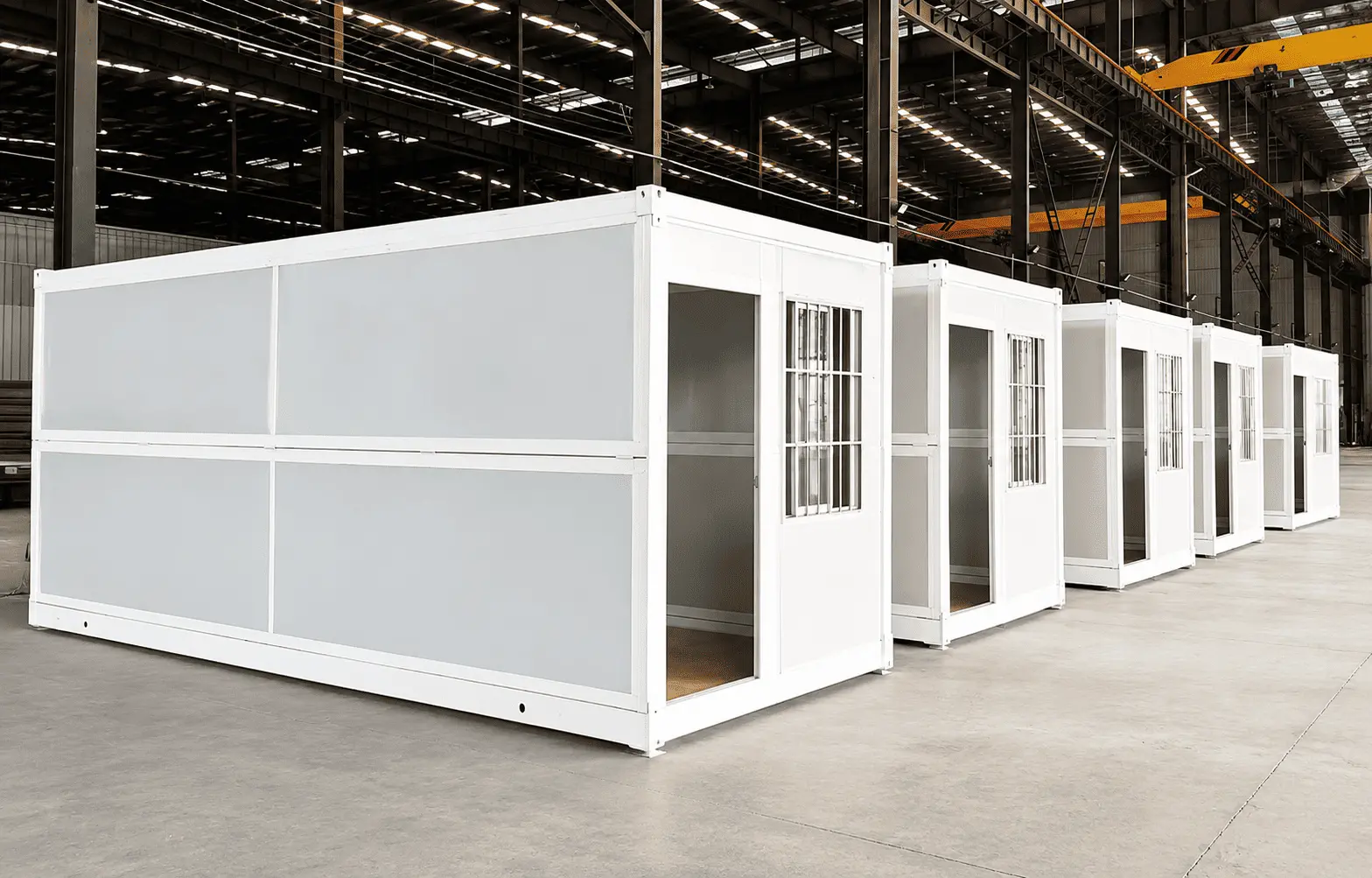
How Does a Foldable Container House Save Shipping Space?
The main reason comes from the folding structure.
A conventional modular building normally occupies close to its usable footprint during transportation unless the manufacturer has designed the components specifically for compact packing. A foldable container house leaves the factory in a folded condition, allowing the main structure to occupy less space before deployment.
Casa Box's X-type design is developed around this principle. The building changes its physical configuration between transportation and site use rather than maintaining the same dimensions throughout the logistics process.
For large orders, this creates a useful relationship between building quantity and container capacity.
Under specified configurations, up to 14 X-type units can be loaded into a 40HC container. The figure should not be treated as a universal loading number for every configuration. Interior layouts, additional equipment, packaging and project-specific accessories can all affect the final loading plan.
For procurement teams, the more useful question is not simply:
How many units fit into one container?
It is:
How many complete project units can be delivered within the available shipping capacity?
That distinction becomes important when comparing different modular systems.
Fewer Containers Can Simplify Large-Project Logistics
Reducing the number of shipping containers does not automatically mean the project will cost a fixed amount less. Ocean freight varies by route, season, destination port and shipping conditions. Inland transportation can also represent a significant portion of the final delivery cost.
There are still several practical advantages to reducing the number of containers.
A large project may have limited space for temporary container storage. The site may also have restrictions on truck access, unloading equipment or delivery times. If too many containers arrive before the site is ready, the project team can end up paying for additional handling or temporary storage.
A more compact loading arrangement gives the logistics team greater flexibility when scheduling deliveries.
For a remote workforce camp, for example, the delivery route may include a port transfer followed by several hours of inland trucking. In some regions, the final section of the route can be more difficult than the international shipment itself. Reducing the number of individual container loads can therefore help simplify the transport plan.
The actual saving should be calculated using the complete delivered cost rather than the ocean freight quotation alone.
What Changes for a 100-Unit Project?
Consider a project requiring 100 foldable container houses.
The first calculation should be based on the manufacturer's confirmed packing plan. If a particular X-type configuration allows up to 14 units per 40HC, the theoretical loading requirement would be approximately eight 40HC containers for 100 units, subject to the actual packing arrangement.
The real shipping plan may be different once furniture, additional components, insulation options, electrical equipment or other project materials are included.
That is why an experienced supplier should provide a packing list and container loading plan before the purchase order is finalized.
For the buyer, several figures can then be compared:
Item | What to Check |
Units per 40HC | Confirmed loading quantity for the selected model |
Total containers | Based on the complete project order |
Packing condition | Folded dimensions and protection method |
Additional components | Whether doors, windows, furniture or utilities affect loading |
Port of destination | Shipping route and handling requirements |
Inland transport | Trucking distance and road conditions |
Unloading | Crane or other lifting requirements |
Delivery sequence | Whether containers arrive in line with site progress |
This information gives the project team a more realistic picture of logistics before production starts.
Transport Planning Should Match Site Progress
There is little value in delivering a large number of units to a site that is not ready to receive them.
The site needs suitable access, prepared foundations or supporting surfaces, unloading space and enough working area for deployment. When several dozen units are involved, delivery should normally be coordinated with the installation sequence.
For example, a worker camp may be divided into accommodation blocks, office areas, dining facilities and service buildings. Deliveries can be organized around these construction phases rather than sending all units to the site at once.
The folded condition of an X-type Foldable Container House can help with this approach because the units occupy less space before deployment. The project team can make better use of temporary storage areas while waiting for the next installation phase.
This can be particularly useful where land is expensive, access is restricted or the project is located in a remote area.
Does a Foldable Container House Always Cost Less to Transport?
Not necessarily.
Transportation cost depends on more than the number of units inside a container. The shipping route, freight market, destination charges, customs duties, inland trucking, crane requirements and local handling costs all affect the final figure.
The folding design provides a transport advantage, but the buyer still needs to calculate the complete logistics chain.
A proper comparison should include:
Product cost + ocean freight + port charges + inland transportation + unloading + site handling
For international modular construction, looking only at the factory quotation can lead to an incomplete comparison.
Two products with similar ex-factory prices may have very different delivered costs if one requires substantially more shipping space.
Why Transport Density Matters for Remote Projects
Remote construction and industrial projects often face tighter logistics conditions than projects close to major cities.
Mining camps, energy projects and large infrastructure sites may be several hours away from the nearest port or major transport hub. Road conditions can limit truck size or delivery frequency. Storage space at the project site may also be restricted.
Under these conditions, transport density becomes a practical project consideration.
A portable foldable container house can arrive in a compact condition, travel through the normal container logistics chain and then be deployed at the final site.
The same principle can apply to temporary housing projects where the buildings may later be moved to another location. The value is not limited to the first shipment. If the structure is designed for repeated deployment and relocation, the original transport strategy can form part of the building's longer service cycle.
Relocation still requires proper planning, including lifting, transportation, site preparation and inspection. Folding the building does not eliminate those requirements.
What Should Buyers Ask a Foldable Container House Manufacturer?
Transport performance should be confirmed before placing a large order.
A supplier should be able to provide clear information about the selected model and its packing condition rather than quoting a general number that applies only to one configuration.
Useful questions include:
1. How many complete units can be loaded into one 40HC container?
2. Is the quoted quantity based on the exact configuration being ordered?
3. What are the folded dimensions of each unit?
4. Will furniture, electrical systems or other accessories change the loading quantity?
5. How are the folded units protected during ocean transportation?
6. Can the supplier provide a container loading diagram?
7. What lifting equipment is required when the units arrive?
8. Can the delivery sequence be matched to the installation schedule?
9. What components need to be shipped separately?
10. What information does the supplier need to calculate the delivered logistics cost?
These questions are more useful than simply asking whether the product has “low shipping costs.”
Transport Efficiency Is Only One Part of the Project
A foldable container house should not be selected only because more units can fit into one container.
The structure still needs to meet the project's requirements for accommodation, office use, weather protection, installation, durability and future maintenance. Site conditions also need to be considered before the transportation plan is finalized.
For a large project, however, transport efficiency can have a noticeable effect on the way the entire supply chain is organized.
Casa Box X-type Foldable Container House is designed with this relationship in mind. The folding structure creates a compact transport condition, while the deployed unit provides the space required for accommodation, offices and other temporary or semi-permanent facilities. Under specified configurations, up to 14 complete units can be loaded into one 40HC container, giving project teams another option when planning large-volume deliveries.
For projects where transportation distance, container availability and site access are major concerns, the packing condition should be reviewed as carefully as the building specification itself.

Content Center
Container house news, guides and project insights.