 en
en
 Italian
  Spanish
  Hungarian
  Thai
Thai  Japanese
  Portuguese
  Malay
Malay  Russian
  French
  German
  Arabic
  Indonesian
How Quickly Can a Z-Type Foldable Container House Be Installed?
For a modular construction project, installation speed affects more than the time required to put a building in place. It also influences labor allocation, lifting equipment schedules, site access and the order in which temporary facilities become available. When a project requires dozens or hundreds of accommodation units, small differences in the installation process can become significant across the entire deployment schedule.
A Z-type Foldable Container House is designed to simplify this process through an integrated linkage folding structure. The top frame, bottom frame and two side wall panels move together during unfolding, reducing the need to assemble individual structural components on site. According to the specified product configuration, 2–3 workers can complete the unfolding of one unit in approximately 3–5 minutes.
That figure provides a useful reference for planning, but it needs to be understood in context. Structural unfolding is only one stage of installation. Site preparation, unloading, positioning, connection checks, utility work and final inspection still need to be included in the project schedule.
For contractors and procurement teams, the more useful question is how the Z-type folding mechanism changes the overall deployment process and what needs to be prepared before the units arrive.
How Does the Z-Type Folding Structure Work?
The main difference lies in the way the building opens.
Conventional modular units may require several separate components to be positioned and connected during installation. Depending on the design, workers may need to handle individual wall panels, roof sections, structural members or loose accessories before the building can take its final shape.
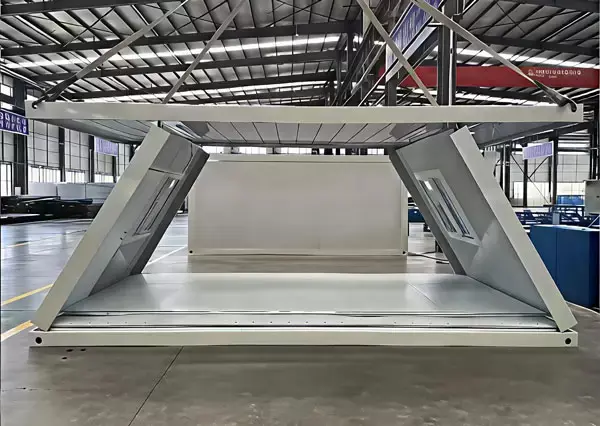
The Z-type folding design uses a coordinated hinge mechanism to connect the main structural sections. During transportation, the unit is folded into a compact configuration. At the destination, the connected sections unfold together through the linkage system.
The top and bottom frames and the two side wall panels move as an integrated assembly. Workers do not need to remove and reinstall each of these main components during the unfolding operation.
This reduces the number of separate assembly steps and helps make the process more repeatable from one unit to the next.
For a contractor managing a large modular housing project, repeatability matters. A process that can be carried out in a consistent sequence is easier to organize than one that depends on multiple independent assembly tasks for every unit.
The actual procedure still depends on the product model, site conditions and manufacturer's instructions. The folding mechanism simplifies the structural deployment stage; it does not eliminate the need for correct handling and installation.
What Does the 3–5 Minute Installation Time Actually Cover?
The stated 3–5 minute figure refers to unfolding a single Z-type unit under suitable conditions. It should not be interpreted as the time required to complete every installation task or prepare a building for occupancy.
A project team needs to distinguish between three stages.
Stage | Main Work | Key Considerations |
|---|---|---|
Structural unfolding | Opening the folded unit through the linkage mechanism | Clear working area, correct operating sequence and trained personnel |
Installation and securing | Positioning, checking connections and tightening the required bolts | Alignment, stability and compliance with installation instructions |
Preparation for use | Electrical connection, utility work, fit-out and inspection | Project specifications, local requirements and commissioning |
The time required for each stage varies. A unit delivered to a prepared site with suitable access will have a different installation schedule from one arriving at a remote location where the ground, lifting area and utility connections are not ready.
The distinction is especially important when preparing a project proposal. A supplier's structural unfolding time can be used as one planning reference, but the contractor should calculate the complete installation and commissioning schedule separately.
What Needs to Be Ready Before the Container Arrives?
Fast deployment begins before the unit reaches the installation area.
If the delivery route is blocked, the ground is unsuitable or the unloading area is too small, workers may have to wait even when the building itself can be unfolded quickly. These delays can affect labor productivity and equipment utilization across the entire site.
A practical installation plan should cover the following areas.
Site preparation
The supporting surface or foundation must meet the project requirements before the unit is positioned. Drainage, level differences, access routes and the arrangement of adjacent buildings should be checked in advance.
Unloading and handling
The project team should confirm the required lifting method and equipment with the manufacturer. The handling procedure must follow the product's lifting points, weight information and safety instructions.
Working space
Workers need enough clearance to unfold the side panels and carry out the required checks. Units should not be delivered so closely together that their deployment interferes with neighboring buildings or site traffic.
Installation sequence
For multiple units, the layout should allow each building to be positioned and unfolded without unnecessary repositioning. Delivery order should follow the actual installation sequence wherever practical.
Utilities and internal fit-out
Electrical systems, water supply, drainage, air conditioning and other services should be planned before installation. The amount of work required will depend on the selected configuration and the intended use.
Preparing these items in advance helps the project team make better use of the folding structure's installation advantage.
How Much Time Can Be Saved on a Large Project?
The benefit of a short unfolding time becomes more apparent when the project involves multiple units.
Consider a project requiring 50 Z-type Foldable Container Houses. If the specified configuration allows each unit to be unfolded in 3–5 minutes, the combined structural unfolding time would be approximately 150–250 minutes for 50 units.
That is a theoretical total of 2.5–4.2 hours of unfolding work across the 50 units. It is not a prediction that the entire project can be completed within that period.
Actual deployment depends on how the work is organized. The units may need to be unloaded individually, moved into position, checked and secured. Some tasks can be coordinated across several units, while others must be completed separately. Worker availability, equipment capacity, weather and site access can also affect the schedule.
For this reason, project planners should avoid simply multiplying the number of units by the advertised unfolding time and treating the result as the final installation duration.
A more useful planning method is to estimate each stage separately:
Delivery and unloading
Positioning and structural unfolding
Securing and inspection
Utility connection
Interior preparation
Final handover
The supplier's unfolding time provides a starting point for this calculation. The rest of the schedule should be based on the actual site plan and scope of work.
Why Does Installation Consistency Matter for Workforce Camps?
A workforce camp requires more coordination than the installation of a single standalone unit.
Accommodation buildings may need to be arranged alongside offices, dining areas, sanitation facilities and shared service areas. Access routes must remain clear, and the installation sequence should not interfere with other construction activities.
The Z-type linkage folding structure can help simplify the repeated deployment of accommodation units because the main structural sections move together. Once the installation team is familiar with the approved procedure, the same sequence can be applied to successive units.
However, consistent installation depends on more than the folding mechanism. Workers need suitable training, clear instructions and an organized work area. Each unit also requires the relevant checks before it is released for use.
For contractors delivering a large worker camp, it is worth preparing a standard installation procedure before mass deployment begins. The procedure can cover unit positioning, unfolding, bolt tightening, structural inspection and the handover of completed units to the next team.
A repeatable process makes it easier to identify delays and maintain consistent workmanship as the number of units increases.
Can a Z-Type Foldable Container House Reduce Labor Requirements?
The integrated folding mechanism can reduce the number of separate assembly operations required on site. The specified configuration can be unfolded by 2–3 workers in approximately 3–5 minutes under suitable conditions.
That does not automatically mean the entire project needs fewer workers or less equipment.
A large installation may still require drivers, lifting-equipment operators, site supervisors, electricians, plumbers and inspection personnel. The number of workers needed depends on the scope of work, the number of units being deployed at the same time and the local safety requirements.
The more useful comparison is the labor and equipment required to complete the same scope of work using different building systems.
When evaluating suppliers, project teams should ask for the recommended crew size, installation procedure, required tools and scope included in the stated installation time. These details make it possible to compare actual site requirements rather than relying on a single headline figure.
What About Safety and Quality During Fast Installation?
Speed should never take priority over correct installation.
The folding mechanism contains moving structural sections and heavy components. Workers must follow the manufacturer's handling instructions and keep clear of moving parts during deployment. Suitable lifting arrangements, a controlled working area and clear communication between team members are essential.
Once the structure has opened, the team should verify that the unit is correctly positioned and that the required connections and bolts have been secured. Any specified locking devices, seals and structural interfaces should be checked according to the installation instructions.
The site team should also inspect the building for damage that may have occurred during transportation or handling.
A quick unfolding process is useful only when the completed unit meets the project's requirements. For accommodation and office applications, the final checks may also cover doors, windows, sealing interfaces, electrical systems and other installed components.
The inspection scope should be agreed before delivery so that the project schedule includes sufficient time for proper verification.
How Does Installation Speed Affect Remote Projects?
Remote projects often face additional constraints. Labor may be difficult to mobilize, accommodation may be needed before the main facility is completed and transporting equipment to the site may require considerable coordination.
In these circumstances, a building system that reduces the number of on-site assembly operations can be useful.
A Z-type Foldable Container House arrives in a folded configuration and opens through its integrated linkage mechanism. The compact transport form can also help the logistics team coordinate the delivery of multiple units, although the final loading quantity depends on the selected configuration and packing plan.
For a remote mining camp, energy project or infrastructure site, the installation schedule should be developed together with the transportation plan. The team needs to know when the units will arrive, where they will be unloaded, how they will be moved into position and when the supporting services will be ready.
The structural unfolding time is one part of that sequence. Its value is greatest when the rest of the site operation has been prepared to support it.
What Should Buyers Confirm Before Ordering?
Before selecting a Z-type Foldable Container House for a large project, buyers should confirm the installation requirements with the manufacturer.
The following questions can help establish a realistic deployment plan:
Does the stated 3–5 minute time refer to structural unfolding only?
What crew size is recommended for the selected configuration?
Which tools and lifting equipment are required?
How should the unit be positioned and secured after unfolding?
What site conditions must be met before delivery?
Which installation tasks are included in the supplier's scope?
How are structural connections and sealing interfaces inspected?
What additional work is required before the unit can be occupied?
Are installation instructions and technical documentation provided?
Can the supplier support planning for a large number of units?
These details should be agreed before production and delivery. They help the buyer compare suppliers on a consistent basis and reduce the risk of discovering additional installation requirements after the units reach the site.
Planning Beyond the Unfolding Time
A Z-type Foldable Container House is designed to make structural deployment straightforward through its integrated linkage folding mechanism. With a specified unfolding time of approximately 3–5 minutes for a single unit under suitable conditions, it can offer a practical option for projects that need to deploy multiple modular buildings.
The actual project schedule still depends on preparation, transportation, positioning, securing, utility connections and inspection. These stages need to be included when estimating the time required to deliver usable accommodation or office space.
For construction contractors, workforce camp operators and modular building distributors, the best results come from treating installation as part of the wider project plan. The manufacturer's stated unfolding time should be verified against the selected model and then incorporated into a schedule that reflects the real site conditions.
Casa Box's Z-type Foldable Container House combines a linked folding structure with a compact transport configuration and a heavy-duty frame design. For projects where rapid deployment is important, buyers should assess the installation procedure alongside transport requirements, intended use and long-term maintenance before confirming the order.
For project-specific installation details and configuration options, contact the Casa Box sales team.
Content Center
Container house news, guides and project insights.